Begin with the plant in people’s hands: a stem, a fibre, a seed. The history of cannabis reaches well beyond the questions most often asked about it today.
In Mandarin, má (麻) and mā (媽, mother) are different words and tones. [5]
To understand cannabis, we have to leave the modern argument behind for a moment and look at a much longer relationship. China and the wider East Asian record are an essential place to begin.
How far back can we see?
In 2021, Guangpeng Ren and colleagues compared cannabis genomes from around the world. Their reconstruction points to early domestication in East Asia, around 12,000 years ago. That is an estimate from a genetic model, with a broad uncertainty range—not a dated manuscript or a single excavated farm.[1]
Physical finds give us another kind of evidence. At Okinoshima in Japan, researchers directly dated cannabis fruits to approximately 10,000 calibrated years before present—roughly 8000 BCE. The remains establish that the plant was there. The authors proposed possible cultivation and use; the fruit alone cannot establish medicine or intoxication.[2]
Three different clocks
A plant’s genetic history. An object’s age. A text’s date. Each tells us something different.
Locate the evidence
East Asia. The eastern Pamirs.
Two places in a wider story. Select a location to see the evidence behind it.
Genetic reconstruction · Regional location
An early cultivated plant
The 2021 study places early domestication in East Asia. The shaded area is a broad locator, not a claimed boundary or the site of the first field. [1]
Archaeological residues · c. 500 BCE
A ceremony preserved in traces
At Jirzankal Cemetery, chemical analysis of wooden braziers supports cannabis burning in funerary rites around 2,500 years ago. [3]
Map: Green Nature 808, using Natural Earth public-domain coastlines. Locations are explanatory; no ancient route is implied.
A mountain cemetery, a different question
The Jirzankal study, published in 2019, examined ten wooden braziers recovered from eight tombs in the eastern Pamirs, in present-day western China. Burnt stones and residues allowed the team to investigate what had been heated inside them. The researchers interpreted the chemistry as evidence for the use of cannabis with psychoactive properties during mortuary ceremonies.[3]
That is a specific finding, tied to objects and a burial context. It does not tell us that every community used cannabis in the same way, or reveal exactly what participants believed. The wider site also points to contacts between communities: the ancient world was connected, even where a modern map appears remote.
The plant in ordinary life
Chinese historical writings record cannabis as a source of fibre and seed, as well as a plant used in medicine. Brand and Zhao’s examination of the bencao literature describes a long record involving clothing, rope, paper and food. It also shows why specifying the plant part matters: seeds, flowering material and stalk fibre have different properties and uses.[4]
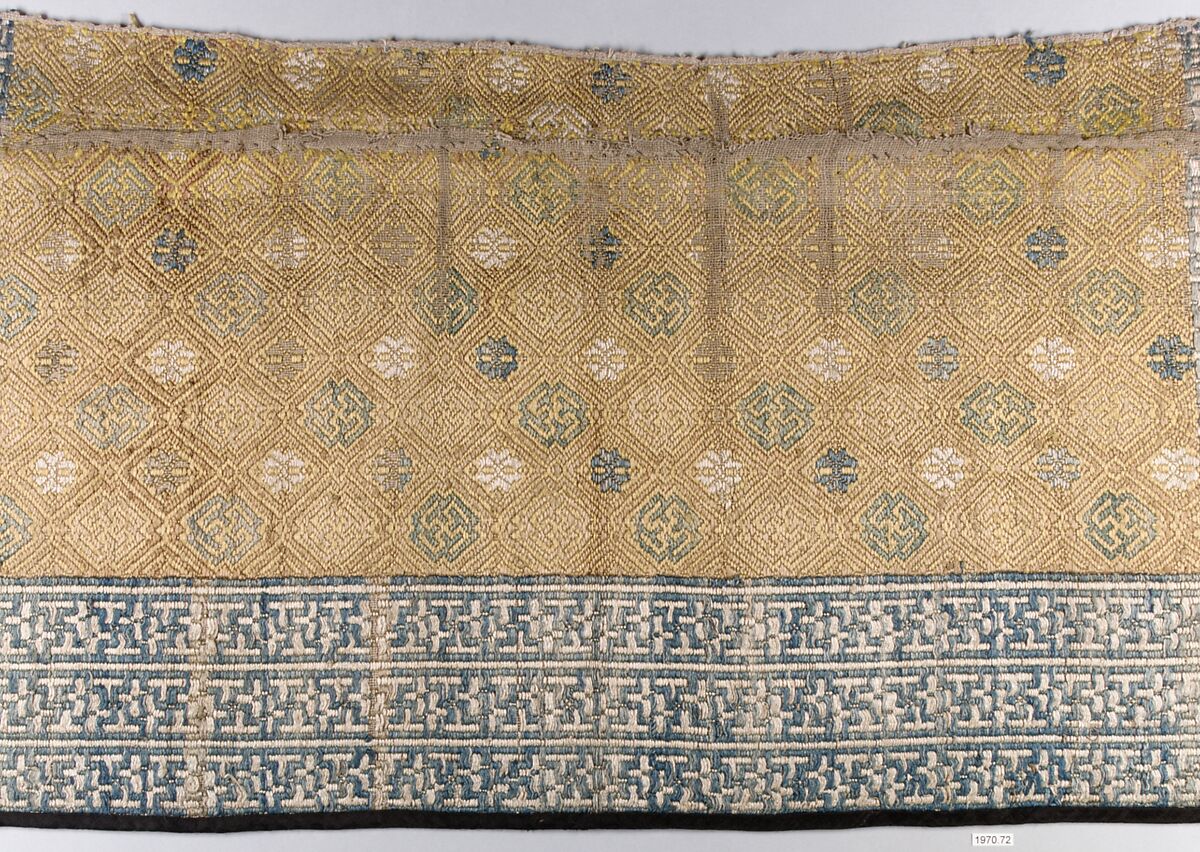
A later thread in the story.Piece from Coverlet, China, nineteenth century: silk on hemp. This much later object illustrates hemp’s place in material culture; it is not evidence of prehistoric use. The Metropolitan Museum of Art, gift of Robert Drummond, 1970, accession 1970.72. Collection record / public domain ↗
When the written record speaks
The Shen Nong Ben Cao Jing, or Divine Farmer’s Classic of Materia Medica, is traditionally associated with the legendary Divine Farmer. The text examined by historians belongs to the first and second centuries CE. Treating it as a surviving document from a legendary ruler’s lifetime would collapse two very different kinds of history.[4]
Later writers compiled, questioned and transmitted earlier descriptions. Some plant-part names remain difficult to interpret. These texts preserve observations and beliefs; translating them into modern diagnoses or proven treatment effects requires evidence they cannot supply on their own.
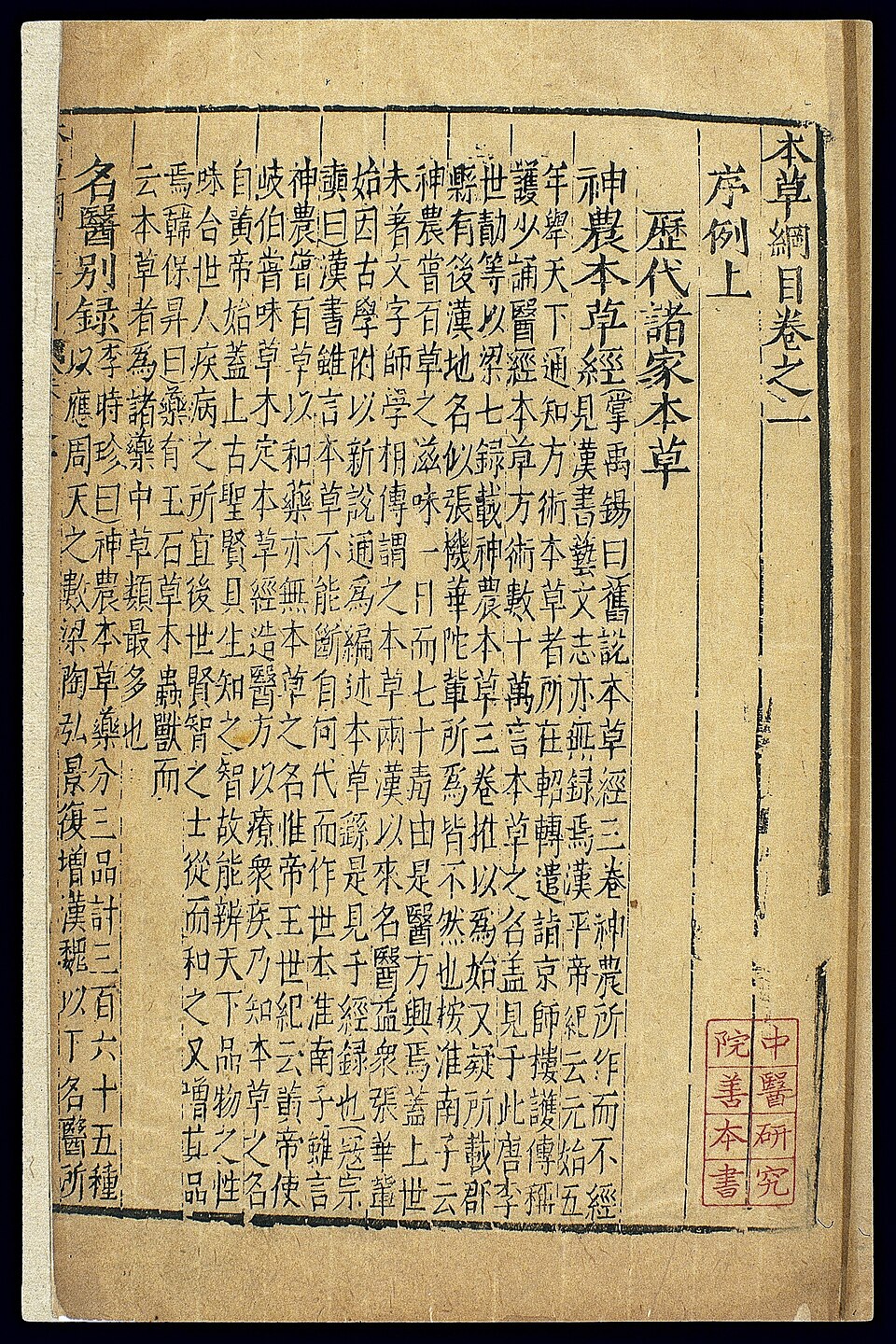
Wellcome Collection, L0039328 · CC BY 4.0. Sixteenth-century Bencao gangmu opening page; source thumbnail, displayed at reduced size. This opening page concerns the history of medical literature; it is not a cannabis prescription.
A beginning, with room to look further
This history is compelling because it is made from different kinds of traces. A seed can survive where a story disappears. A book can carry an observation across centuries. A laboratory can ask a new question of an object excavated years earlier.
We begin in China without pretending that one modern border contains the whole story. The next step is outward: to neighbouring societies, different traditions, trade, migration and the places where evidence still leaves us with questions.