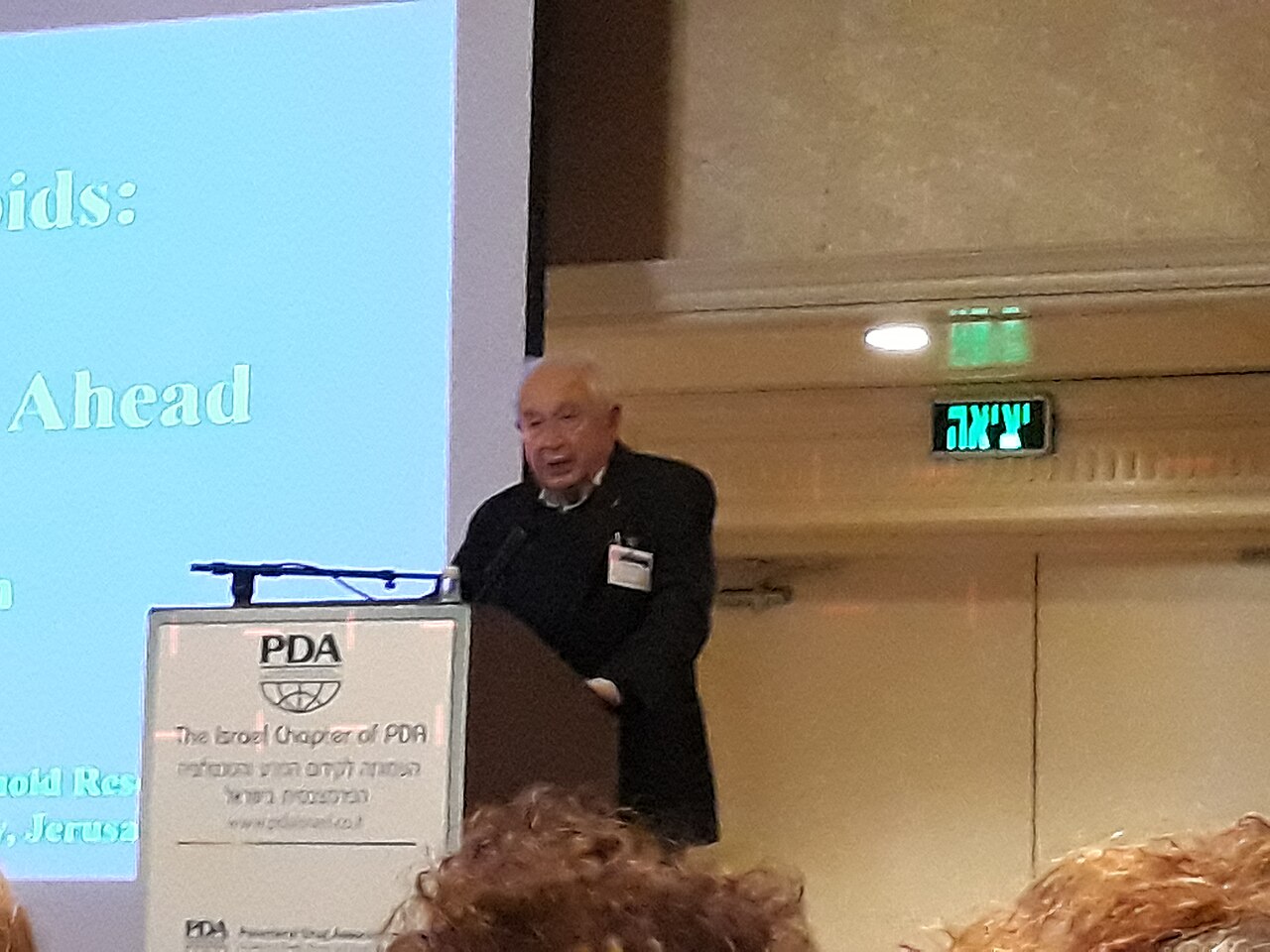
What, exactly, is in this plant? And what happens when its compounds meet a living body? Raphael Mechoulam spent decades helping to turn those broad questions into things that could be identified, measured and tested.
Born in Sofia in 1930, he moved to Israel in 1949. His scientific training took him through the Hebrew University, the Weizmann Institute and postdoctoral research at the Rockefeller Institute in New York. He established a research group at Weizmann in 1960 and moved to the Hebrew University in 1966.[1]
The questions of a chemist
A plant preparation is a mixture. To investigate one of its constituents, researchers need to know what that constituent is. Identifying its molecular structure makes a more precise kind of enquiry possible: one compound can be distinguished from another, and results can be connected to a defined substance.
In 1963, Mechoulam and Yuval Shvo published The structure of cannabidiol. The wording matters. This was work establishing the structure of CBD; it should not be retold as though CBD had never been isolated before their paper.[2]
In 1964, Yehiel Gaoni and Mechoulam reported the isolation, structure and partial synthesis of the principal intoxicating constituent of cannabis, tetrahydrocannabinol, commonly called THC. This was a landmark in the chemistry of the plant, rather than proof that it could treat a particular illness.[1][3]
Discovery is shared
Mechoulam is often described as the father of cannabinoid research. It is an understandable tribute, but a single name can hide a great deal of shared work. Shvo and Gaoni belong in the early chapters. The later papers contain teams of chemists and pharmacologists working together across institutions.[2][3][4]
Following those author lists changes how we tell the story. Progress did not arrive as one solitary revelation. It emerged through successive experiments, different methods and questions that one group’s findings allowed another group to pursue.
The epilepsy research — and the long wait
The early epilepsy work deserves a chapter of its own. In 1980, J. M. Cunha, Elisaldo Carlini, Mechoulam and colleagues published a small study involving people whose epilepsy remained uncontrolled by their existing medicines. Those medicines were continued during the study. Of eight participants receiving CBD, four were reported to have remained almost free of convulsive episodes and three showed partial improvement.[7]
It was a promising early result, but a small study, not a demonstration that CBD would work for every patient. The result did not establish how other age groups or forms of epilepsy would respond.
There is a documented connection to 1972: Carlini and Cunha’s 1981 review described a programme of CBD studies in their laboratory beginning that year, covering healthy volunteers, sleep and epilepsy. The dates of the wider research programme and the published epilepsy trial should be distinguished.[8]
Mechoulam later expressed frustration at the lack of follow-up. In a 2018 interview with Chemical & Engineering News, discussing the 1980 results, he said: “I was surprised and disappointed that nothing happened.” It is a revealing part of the story: publication did not bring the response he had hoped for.[10]
Decades later, larger studies provided more substantial evidence for particular childhood epilepsy syndromes. A 2017 randomised trial involving 120 children and young adults with Dravet syndrome found a greater reduction in convulsive-seizure frequency with a defined cannabidiol oral solution than with placebo. Adverse events were more frequent in the cannabidiol group. These results concern the medicine and patients studied, not all CBD products or every form of epilepsy.[9]
The early researchers, the later clinical teams and the families who took part all belong in this account. Mechoulam’s place in it is substantial without attributing the whole achievement to one person.
The body’s own signals
In 1992, William Devane, Lumír Hanuš, Mechoulam and colleagues reported a compound isolated from pig brain that bound to the cannabinoid receptor. They called it anandamide. Its structure was established using mass spectrometry and nuclear magnetic resonance, then checked through synthesis.[4]
This shifted the focus beyond the plant. A substance produced within an animal could interact with the same receptor under investigation in cannabinoid research. The paper proposed anandamide as a naturally occurring ligand: in plain language, a molecule capable of binding to that receptor.
In 1995, a team including Mechoulam, Shimon Ben-Shabat and Hanuš reported another endogenous compound, 2-arachidonoylglycerol, or 2-AG, isolated from canine intestine. Their experiments examined its binding to cannabinoid receptors and its biological effects. The paper was laboratory and animal research, not a clinical trial in people.[5]
Endogenous means produced within the body. An endocannabinoid is a body-produced compound that acts at cannabinoid receptors.
These discoveries helped establish the study of the endocannabinoid system. They opened questions about the body’s own signalling processes; they did not, by themselves, establish that a commercial cannabis extract would be safe or effective for a particular patient.
The person behind the papers
In his 2023 autobiographical review, Mechoulam looked back on a scientific life that followed a traumatic wartime childhood. He described the freedom to pursue his own scientific interests as the most satisfying part of his work. The account also noted how much remained to be investigated in humans.[6]
That distinction is central to how we remember his work here. Scientific curiosity can be ambitious while remaining precise about what has, and has not, been shown. His contribution gave others better tools with which to ask the next question.
Watch & listen
The Scientist
The 2015 documentary follows Mechoulam’s life and research. Watch through Fundación CANNA, which collaborated on the film.
Watch the documentary on its host’s website ↗For another first-hand account, listen to his 2018 interview with the International League Against Epilepsy. These recordings are historical accounts; statements about treatment should be read in their original context.
Papers to follow
- 1963
- CBD structure — Mechoulam and Shvo.
- 1964
- Cannabinoid chemistry — Gaoni and Mechoulam.
- 1980
- Early clinical epilepsy study — Cunha and colleagues.
- 1992
- Anandamide — Devane and colleagues.
- 1995
- 2-AG — Mechoulam and colleagues.
Read the evidence
Sources & further reading
Original publications are linked alongside institutional accounts. Historical observations are reported as such; they are not presented as modern treatment guidance.
- Weizmann Institute — Professor Raphael Mechoulam ↗
Institutional biography: education, research appointments and the 1964 work.
- Mechoulam & Shvo — Hashish. I. The structure of cannabidiol ↗
Tetrahedron 19(12), 2073–2078 (1963). DOI: 10.1016/0040-4020(63)85022-X.
- Gaoni & Mechoulam — Isolation, Structure, and Partial Synthesis of an Active Constituent of Hashish ↗
Journal of the American Chemical Society 86(8), 1646–1647 (1964). Original publication; full text may require access.
- Devane and colleagues — Isolation and structure of a brain constituent that binds to the cannabinoid receptor ↗
Science 258(5090), 1946–1949 (1992). Original anandamide research; abstract and author list.
- Mechoulam and colleagues — Identification of an endogenous 2-monoglyceride, present in canine gut, that binds to cannabinoid receptors ↗
Biochemical Pharmacology 50(1), 83–90 (1995). Original 2-AG research; abstract and author list.
- Mechoulam — A Delightful Trip Along the Pathway of Cannabinoid and Endocannabinoid Chemistry and Pharmacology ↗
Annual Review of Pharmacology and Toxicology 63, 1–13 (2023). Autobiographical review; abstract hosted by the Hebrew University.
- Cunha and colleagues — Chronic administration of cannabidiol to healthy volunteers and epileptic patients ↗
Pharmacology (1980). DOI: 10.1159/000137430. Original clinical study; the results above follow its abstract.
- Carlini & Cunha — Hypnotic and antiepileptic effects of cannabidiol ↗
Journal of Clinical Pharmacology 21(S1), 417S–427S (1981). The authors describe their laboratory’s programme from 1972; the clinical study cited above was published in 1980.
- Devinsky and colleagues — Trial of Cannabidiol for Drug-Resistant Seizures in the Dravet Syndrome ↗
New England Journal of Medicine 376, 2011–2020 (2017). Randomised, placebo-controlled trial; benefits and adverse events reported together.
- Chemical & Engineering News — CBD: Medicine from marijuana ↗
2018 reporting including a direct interview with Mechoulam about the response to the 1980 epilepsy study. Used for his recollection, not as a substitute for the clinical paper.
Published and sources checked: 16 October 2026. Suggest a correction.