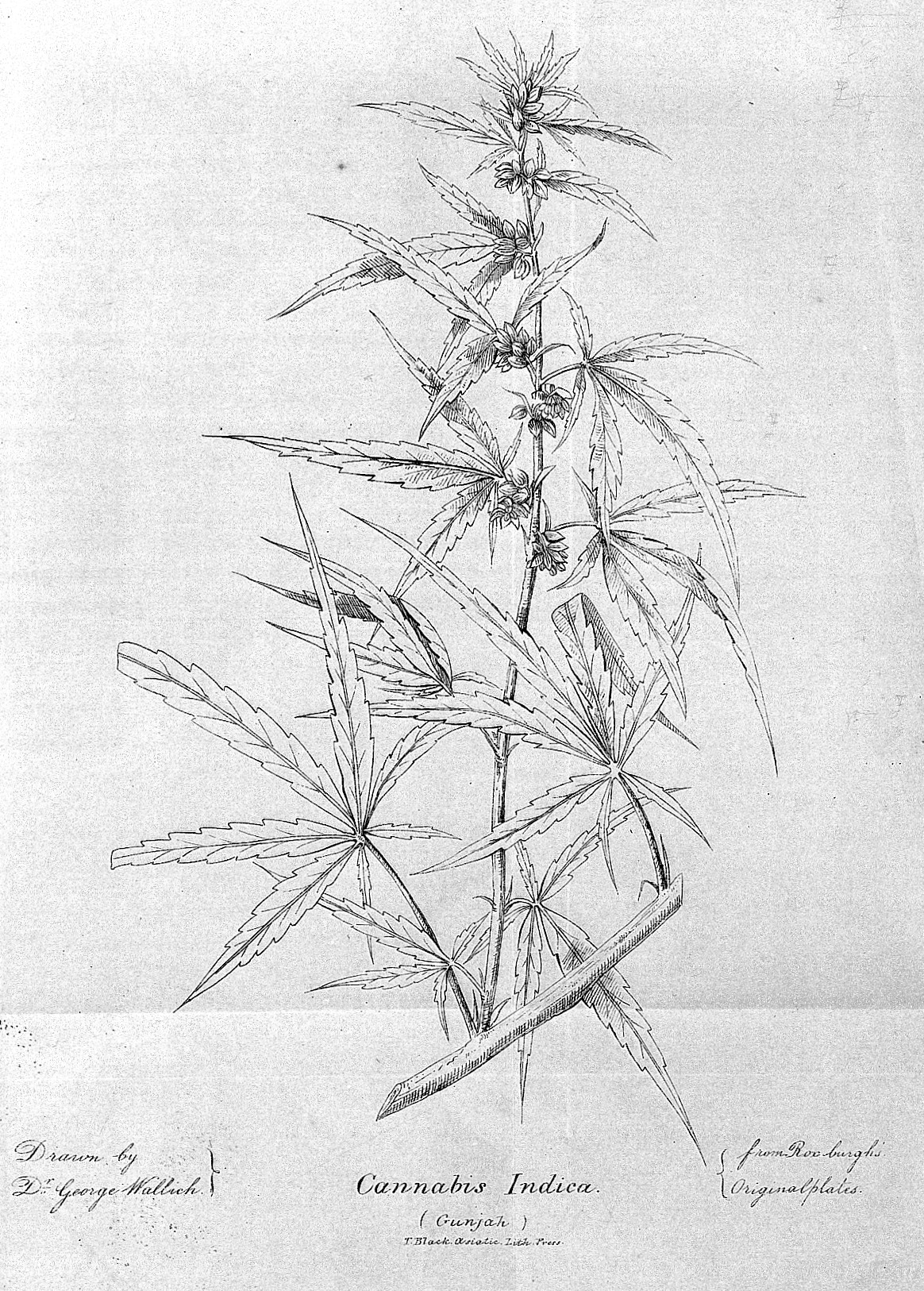
Before the laboratory chemistry, there were people observing a plant. In Calcutta in the 1830s, William Brooke O’Shaughnessy set out to investigate something that local practitioners and communities already knew well: cannabis had effects worth studying.
An Irish physician trained in Edinburgh, O’Shaughnessy worked across chemistry and medicine. His career also included cholera research and, later, electric telegraphy in India. But it is his work on Indian hemp that gives him a particular place in this history.[1]
Knowledge before discovery
Calling him the man who “discovered medicinal cannabis” would miss the beginning of the story. His own paper describes existing medical uses and draws on Sanskrit, Arabic and Persian writings. It names the people who helped him understand them.
Among those acknowledged were Syed Keramut Ali and Hakim Mirza Abdul Razes, alongside scholars who supplied material from Sanskrit texts and other medical traditions. O’Shaughnessy also described watching Ameer, a maker of hemp preparations in Calcutta, at work. These were sources of knowledge, not merely a backdrop to his investigation.[2]
The paper belongs to colonial India, and some of its language reflects the prejudices of that setting. Reading it today means recognising both the work it records and the unequal world in which that work was written.
He helped bring established knowledge into a different medical literature. The knowledge did not begin with him.
Inside the case reports
The 1839 publication moves from accounts of preparations and their use to experiments on animals and observations in patients. The conditions discussed include rheumatism, tetanus and convulsions. A revised version appeared in the Provincial Medical Journal in 1843.[2][3][4]
The details are less tidy than a simple success story. In one account, patients given a hemp preparation responded very differently: one became markedly intoxicated, while another showed no apparent effect. O’Shaughnessy recorded episodes of profound immobility as well as relief he believed he had observed. These descriptions make the uncertainty visible.
Another case concerned an infant with severe convulsions. He reported periods of improvement, recurrence and changes in response. At one point, he found that alcohol had evaporated from a poorly stoppered bottle and the resin had settled on its sides. The preparation being given was no longer what he thought it was. It is a striking example of how the handling of a medicine can complicate the interpretation of a result.[2]
These accounts contain frightened families, seriously ill patients and a doctor trying to make sense of what he saw. They deserve to be read with care, without turning either the suffering or the reported improvements into a modern promise.
What the evidence means
Historical case reports are not controlled clinical trials. They cannot establish the effectiveness, safety or appropriate dose of a present-day product. Other treatments, changing preparations and the course of illness make it difficult to attribute an outcome to one cause. The treatments described in the original paper should not be copied.
O’Shaughnessy’s lasting place in this story is therefore more specific than the discovery of a cure. He documented an investigation, acknowledged earlier knowledge and helped bring Indian hemp into European medical discussion. His paper offers an early record of both therapeutic interest and the practical difficulties of studying a variable plant preparation.[1][2]
For The Cannabis Story So Far, it is a fitting place to begin: with curiosity, with the people who supplied the knowledge, and with an account that leaves us questions as well as observations.
Three points in the record
- 1838
- Patient observations described in the paper.
- 1839
- Calcutta publication held by Wellcome Collection.
- 1843
- Revised publication in the Provincial Medical Journal.
Read the evidence
Sources & further reading
Original publications are linked alongside institutional accounts. Historical observations are reported as such; they are not presented as modern treatment guidance.
- Neil MacGillivray — O’Shaughnessy: chemical pathologist, pharmacologist and pioneer in electric telegraphy ↗
Journal of Medical Biography, 25(3), 186–196 (2017; published online 2015). Biographical cross-check.
- W. B. O’Shaughnessy — On the Preparations of the Indian Hemp, or Gunjah ↗
Public-domain transcription of the historical reprint. See acknowledgements, rheumatism and infantile convulsions. The reprint contains a conflicting date reference; the 1839 date here follows the Wellcome edition and the 1843 journal footnote.
- Wellcome Collection — the 1839 Calcutta edition ↗
Catalogue and digitised original, Bishop’s College Press. Source for the edition date and archive image.
- O’Shaughnessy — revised paper, 4 February 1843 ↗
Provincial Medical and Surgical Journal, s1-5, 363–369. DOI: 10.1136/bmj.s1-5.123.363. The journal identifies the earlier Calcutta publication as 1839.
Published and sources checked: 16 October 2026. Suggest a correction.