Picture a car factory. Then picture the field supplying some of its raw materials.
Ford’s experiments make that connection tangible. The much-repeated “hemp car” story begins with real research into plant materials. Looking closely reveals several different experiments, rather than one simple recipe.
01 / A place for the farmer.
The Henry Ford museum’s soybean collection traces a programme that turned agricultural research towards manufacturing. By 1933, soybean oil was going into paints, and soybean meal into moulded parts such as gearshift knobs. The ambition extended beyond a single crop: connect what farmers could grow with what factories needed.1
A small component is a useful place to begin. It can be made, fitted, handled and evaluated. The more ambitious question was whether plant materials could also contribute to the body of a car.
02 / Where hemp enters the record.
A March 1941 Popular Science report by Schuyler Van Duyne gives us a specific example. It describes chemist Robert Boyer making an experimental rear boot lid for Ford’s personal car using hemp, flax and ramie fibres. The fibres were matted, impregnated with a phenolic resin and shaped under heat and pressure.2
The experiment in plain English
Plant fibres + resin + heat and pressure.
Hemp was one fibre in a manufactured composite. The report distinguishes the farm-grown fibres from the synthetic binder.
This is a much more useful description than “a car made of hemp”. It identifies the component and explains how it was produced. It also gives the reader a contemporary source to inspect.
03 / A car, and an unanswered question.
On 13 August 1941, Ford unveiled a plastic-bodied prototype at Dearborn Days. Fourteen plastic panels were attached to a tubular steel frame. The Henry Ford museum says the exact panel formula has not survived; accounts of its ingredients differ.3
We can therefore report hemp in the earlier boot-lid experiment without pretending that we possess a verified recipe for every panel of the later car.
There is another easily missed detail. The famous axe demonstration involved Ford’s personal car fitted with a plastic rear deck lid—not the prototype. An impact demonstration is not a general proof that hemp is stronger than steel.3
Open the archive
See the objects behind the story.
Ford and Boyer with the 1941 car ↗The boot-lid demonstration ↗Original collection photographs at The Henry Ford.
A useful idea outlives a prototype.
The museum records that wartime disruption halted the experiment and that it never became a production car.3 That outcome leaves an interesting question: what separates a promising material from something a factory can reliably use?
Our reading of the story is practical. A crop is the beginning. Processing, formulation, testing and manufacturing determine what it can become. Ford’s experiments invite us to examine that whole journey, with hemp as one material among several.
It is a good bridge from history to the present: follow the fibre into a fabric, the woody core into a building product, or the seed into food. Each route has its own evidence—and its own work still to do.
Follow the sources
The paper trail.
- The Henry Ford, Henry Ford: Soybeans. Museum collection records for agricultural research and early industrial applications.
- Schuyler Van Duyne, Popular Science, March 1941: “Henry Ford Demonstrates Plastic Bodies for Cars / Mr. Ford Tells of Plans for Stronger Cars”. Contemporary article reproduced by Undiscovered Classics. The hemp, flax, ramie and resin description concerns the experimental boot lid. The report’s predictions are not evidence of later production.
- The Henry Ford, Soybean Car: research notes. Sources for the unveiling, construction, uncertain panel composition, axe-demonstration distinction and project outcome.
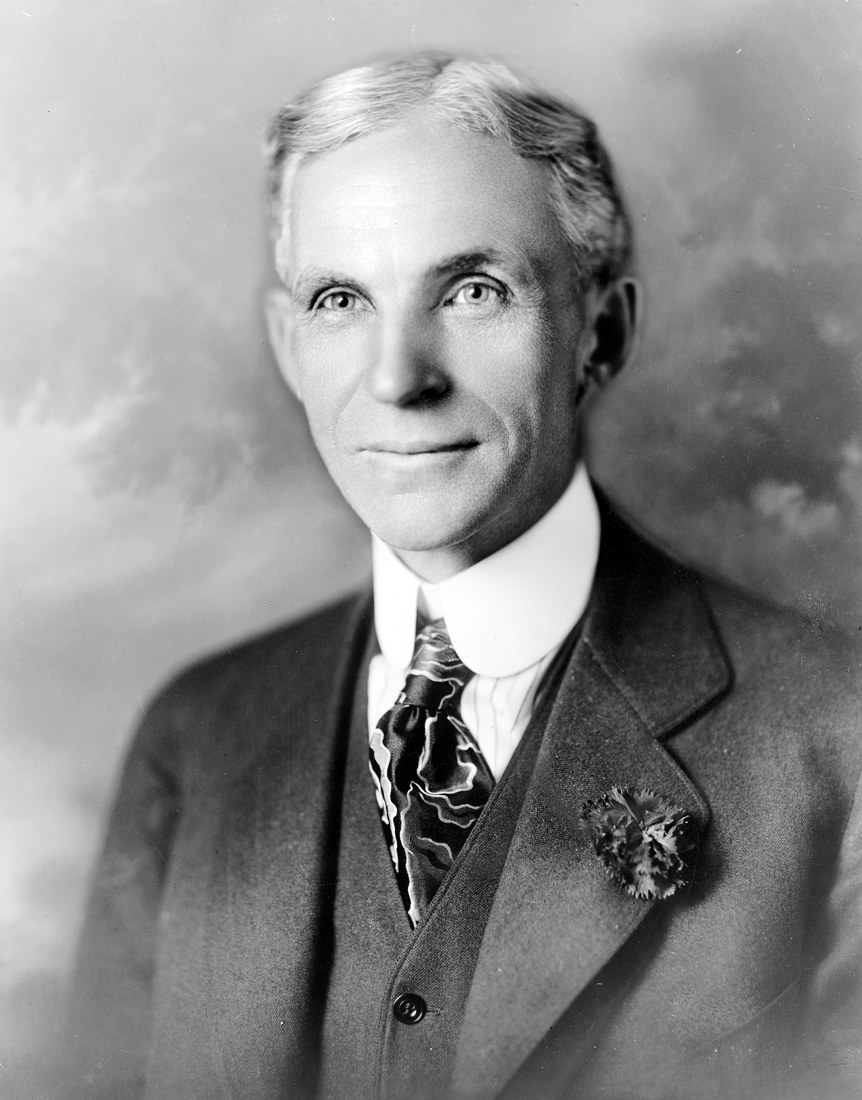
- Portrait: Fred Hartsook, circa 1919, Library of Congress, digital ID cph.3c11278; public domain / no known copyright restrictions. The portrait predates the experiments described here.

Sources checked 19 October 2026. Historical materials feature. Museum and manufacturer references do not imply endorsement.